




By Male Solomon Grace, X: @musomesaug (0778299697)
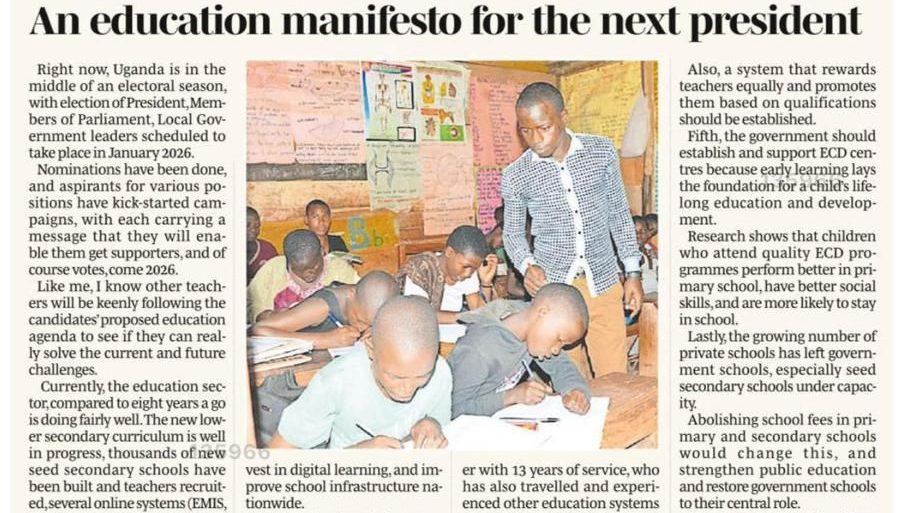
The issues raised by teacher and education advocate Emmanuel Angoda in the LETTER OF THE DAY published in the Daily Monitor on Friday, November 07, 2025 reflect the concerns of many Ugandans who want a modern, fair, and accountable education system. With 13 years of classroom experience and exposure to global systems, his call for curriculum reform, stronger accountability, teacher welfare, digital learning, ECD investment, and revitalisation of public schools is valid and timely. What is equally important, however, is acknowledging that the NRM Government has already taken major steps to address these very concerns through clear programmes, substantial investments, and presidential directives under the NRM Manifesto 2021–2026 and the emerging 2026–2031 agenda.
What baffles me is that critics often recycle long-standing complaints about Uganda’s education system while ignoring who created these problems and who is now fixing them. Anyway… Many of the challenges they highlight revolve around absenteeism, weak inspection, inflated enrolment, and misallocation of funds, which have thrived under outdated, analog systems that previous leaderships refused to modernize. The reforms now in place directly dismantle those loopholes. For example, lately, the TELA system records teacher attendance in real time, raising attendance from below 50% to about 70% in two years. EMIS assigns every learner a unique identification number (LIN), eliminating inflated enrolment. TMIS maintains a verified national database of all teachers, streamlining deployment and reducing ghost staffing. The Electronic Inspection System, supported by GPS-enabled tablets, has increased inspection coverage to 86% nationally. These digital tools form the backbone of the Government’s accountability strategy and reinforce President Museveni’s position that corruption must be defeated using science enabled supervision, and oversight.


As curriculum reform remains central to the system’s transformation, the Lower Secondary Competence-Based Curriculum (CBC), implemented in 2020, produced its first UCE cohort in 2024, with 98% candidates demonstrating the desired competency acceptable for transition to the next level by UNEB. NCDC is finalising new Primary and A-Level curricula that strengthen STEM, technology, entrepreneurship, and value addition. These reforms as well reflect the President’s long-held belief that education should produce problem-solvers and job creators, not job-seekers.
The government has recruited 7,565 secondary teachers, 1,191 support staff for new schools, and 2,263 primary teachers since 2021, with an additional 2,294 positions planned for FY 2025/26. Salary enhancement is being phased sustainably, consistent with the principle that pay reform must be harmonised across public servants on similar scales. Teacher welfare is also being strengthened with new teacher housing constructed under various education projects to improve conditions and retention.
The idea of digitisation of learning is advancing rapidly, whereby the Digital Agenda for Education and Sports (2024) states that there should be ICT integration in schools nationwide. A notable example is that every newly built Seed Secondary School now features a fully equipped ICT laboratory, with UGX 43.51 billion invested in ICT equipment since 2021. The next NRM Manifesto expands ICT access through universal digital literacy, solar-powered labs, and nationwide school internet connectivity. Brilliant! Uganda, you MUST be ready for this.
Early Childhood Development (ECD) has received unprecedented investment since all 23 Primary Teacher Colleges now train ECD caregivers, supported by 6,580 government-sponsored scholarships between 2023 and 2025. The ECD Policy (May 2024) and national Minimum Standards (February 2025) lay the foundation for high-quality early learning. The government plans to establish parish-level ECD centres in the next manifesto cycle. I am personally more excited.
Concerns about pressure on public schools are also being addressed through the largest construction programme in Uganda’s history: 375 Secondary Schools nationwide, with 197 completed and 62 under construction. Rehabilitation of 120 traditional secondary schools and 66 special needs institutions is ongoing. Capitation grants have been increased; UPE from UGX 8,000 to 20,000 per pupil and USE from UGX 123,000 to 175,000, reducing the financial burden on parents and strengthening school operations.
As of the 2025 national examination cycle, the Uganda National Examinations Board (UNEB) registered 1,416,468 candidates for PLE, UCE, and UACE, marking a 7.5% increase from 2024. Of these, 719,016 candidates (51%) are supported by the government under the Universal Education Programmes, which include Universal Primary Education (UPE), Universal Secondary Education (USE), and Universal Post-O-Level Education and Training (UPOLET).
The government has also broadened higher education opportunities through bilateral scholarships with China, Russia, India, Algeria, Egypt, Turkey, South Korea, Japan, and Cuba, enabling Ugandans to study critical fields such as ICT, engineering, medicine, petroleum studies, and agriculture. The Higher Education Students Financing Secretariat (HESFS), formerly HESFB, supported 5,347 students with accessible study loan scholarships between 2021 and 2025, with improved recovery rates ensuring long-term sustainability as a revolving fund.
National skilling programmes continue to transform livelihoods like the Presidential Initiative on Skilling the Girl and Boy Child through the 9 skilling centres located at Wandegeya, Mulago, Mutundwe, Nakulabye, Luzira, Kampala subway, Wabigalo, Kigowa, and Kikoni, targeting to equip thousands of vulnerable families, school dropouts, and the ghetto youths with practical skills in tailoring, welding, bakery, mechanics, and offer a seed capital to the graduates. The 19 zonal/sub-regional Presidential Industrial Hubs offer advanced industrial training and skilling to citizens in carpentry, metal fabrication, and construction and machinery operation, whereby the graduates, after a six-month course, benefit from a UGX 50million Sacco revolving fund to start businesses. These initiatives reflect the President’s belief that Uganda’s growth depends on a skilled, innovative workforce capable of supporting industrialisation.
Technical and Vocational Education and Training (TVET) remains a cornerstone of the President’s vision for human capital development. The TVET Policy and TVET Act have reorganised the sector into a unified, competency-based and labour-market–responsive system. The TVET Council now oversees Uganda Vocational and Technical Assessment Board’s (UVTAB) standardised certification, while dozens of technical institutes have been constructed or upgraded to centres of excellence through programmes such as the Skills Development Fund. The Education Policy Review Commission (EPRC) recently completed a nationwide review of the education system, drawing on consultations with teachers, learners, communities, and experts. I have no doubt that its recommendations will guide a new policy framework aligned with Vision 2040, NDP IV, and the forthcoming NRM 2026–2031 education agenda.
Some commentators continue to blame the central government for teacher shortages without acknowledging that the recruitment of primary teachers is a fully decentralised mandate of the District Service Commissions (DSCs). These commissions are responsible for recruiting over 147,000 primary teachers, yet many districts fail to recruit even when wage allocations exist. This time, the manifesto addresses this by tightening supervision over DSCs, enforcing timely recruitment, and holding local governments accountable. Education does not fail at the centre, but it fails at a point where districts neglect their legal responsibilities.
Taken together, these reforms across basic, secondary, vocational, higher education, and national skilling are implemented through a multi-sectoral approach and directly respond to the concerns raised by Mr. Angoda and many other Ugandans. They demonstrate a Government that is listening, acting, and investing on a national scale. Therefore, as the country approaches the 2026 election period, citizens will rightly ask who is best placed to consolidate these gains, right? President Museveni’s record from UPE in 1997 and USE in 2007 to today’s digital reforms and skilling revolution offers a foundation of consistency and trust. His long-term vision, policy stability, and proven capacity make him, for many, the most reliable leader to guide Uganda’s education and human capital development into a modern, equitable, and globally competitive future.
Read more via : <em><strong>Museveni’s Message of Peace and Prosperity Resonates in Teso</strong></em>
Also read : mrupdates.com




Discussion about this post